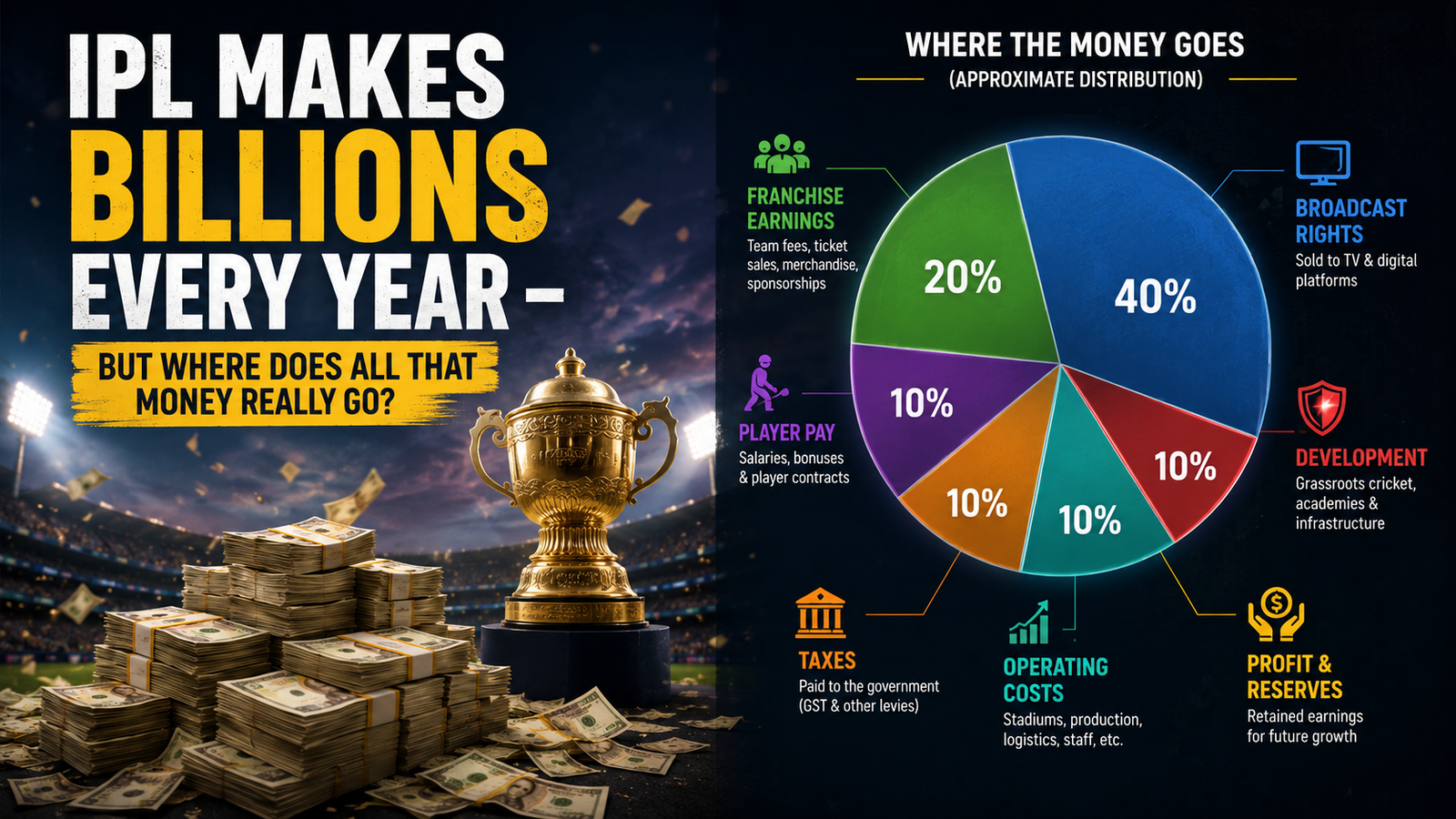
The Billion-Dollar Business Behind the IPL:
Did you know that the Indian Premier League (IPL) earns more money per match than many of the world’s biggest sporting leagues?”
In just around 74 matches, the IPL generates billions of dollars, making it one of the richest sporting tournaments on Earth. What started in 2008 as an ambitious cricket league has transformed into a global entertainment powerhouse, attracting millions of viewers, celebrities, multinational brands, and investors.
But here’s the question that few fans ask while cheering for sixes and wickets:
Where does all that money actually go?
The Numbers That Will Surprise You
The IPL is no longer just a cricket tournament, it’s an economic giant.
● The IPL brand value is estimated at over $16 billion.
● The media rights for the 2023 to 2027 cycle were sold for approximately $6.2 billion, making IPL one of the most valuable sports properties in the world on a per-match basis.
● The league attracts 600 million+ viewers every season across television and digital platforms.
● More than 100 major brands compete for sponsorships every year.
● The title sponsor alone pays hundreds of millions of dollars over a multi-year deal.
These numbers prove one thing:
Every ball bowled in the IPL is worth money.
So, How Does the IPL Earn So Much Money?
The IPL has multiple streams of income.
1. Media Rights-The Biggest Jackpot:
Television broadcasters and streaming platforms pay enormous amounts for the rights to broadcast IPL matches.The latest media rights deal alone is worth around $6.2 billion, contributing the largest share of IPL revenue.
2. Sponsorships:
From jerseys and stadium branding to strategic time-outs and the title sponsorship, companies spend huge sums to associate themselves with the IPL because millions of fans are watching.
3. Franchise Fees:
Each franchise pays fees to the governing body while also investing heavily in players, staff, marketing, and operations.
4. Ticket Sales:
Packed stadiums generate substantial revenue through ticket sales, hospitality packages, and VIP experiences.
5. Merchandise & Licensing:
Team jerseys, caps, accessories, collectibles, and licensed products contribute additional income while strengthening fan loyalty.
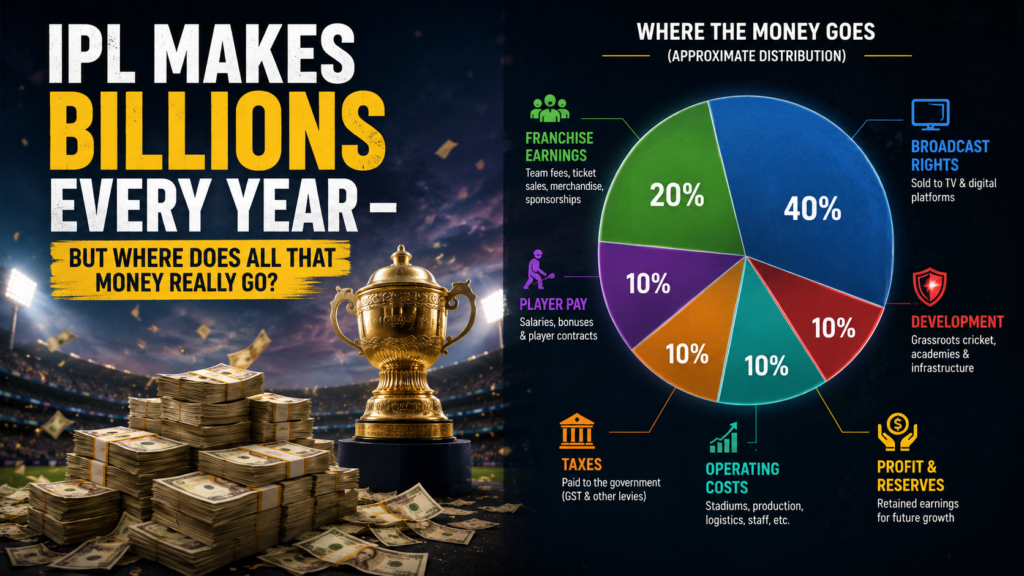
Where Does All That Money Go?
Many people assume the money goes only to star cricketers. The reality is much more complex.
1. Revenue Shared With Franchises:
A significant portion of the IPL’s central revenue is distributed among the franchises. This helps teams cover operating expenses and build stronger squads.
2. Player Salaries:
The IPL auction grabs headlines every year. Top international and Indian players often earn millions of dollars in a single season. However, beyond the stars, many uncapped Indian players also receive life-changing contracts that provide financial security for their families.
For some young cricketers from small towns, one IPL contract can completely change their future.
3. The BCCI:
A large share of the earnings goes to the Board of Control for Cricket in India (BCCI).
These funds are used for:
● Organizing domestic cricket
● Developing stadium infrastructure
● Supporting state cricket associations
● Running women’s cricket programs
● Investing in grassroots cricket development
4. Match Operations:
Hosting an IPL match isn’t cheap.
Money is spent on:
● Stadium maintenance
● Security personnel
● Broadcasting technology
● Ground staff
● Travel and accommodation
● Event management
● Medical teams
● Lighting and logistics
Every match is a massive operation involving thousands of people behind the scenes.
5. Taxes and Government Revenue:
The IPL also contributes significantly through taxes, tourism, hospitality, transportation, and local businesses, creating a broader economic impact beyond cricket.
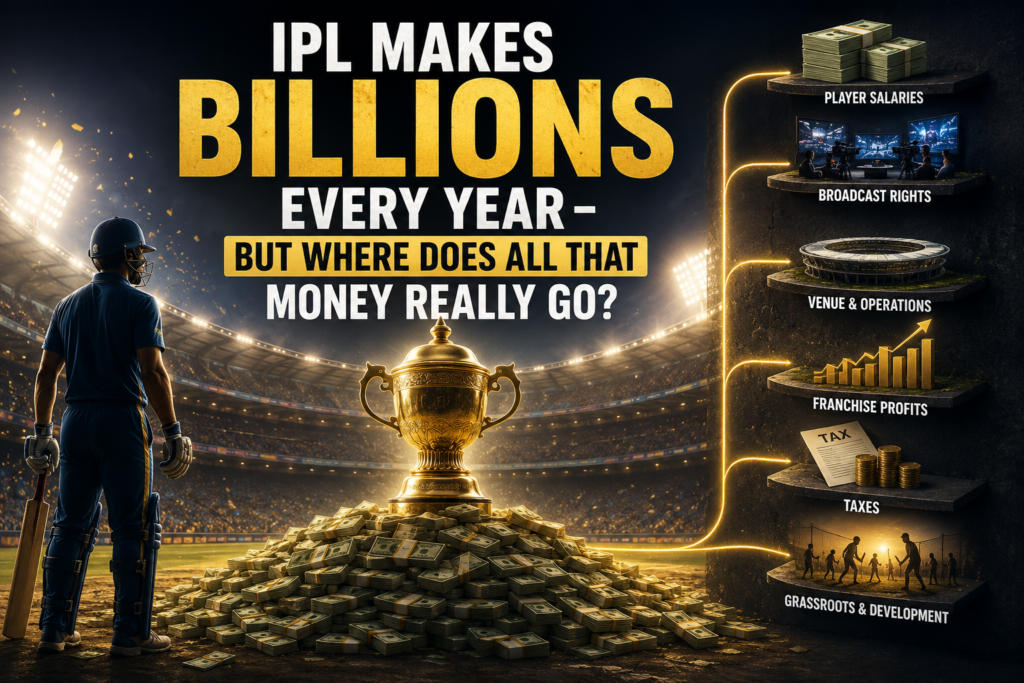
The Emotional Side of the IPL:
For millions of Indians, the IPL is more than entertainment. It has given unknown cricketers a national stage.
Young players from villages and small towns suddenly find themselves sharing dressing rooms with the world’s greatest cricketers. Families who struggled financially have seen their lives transformed overnight because of one outstanding season.
The IPL also creates thousands of temporary jobs every year – from camera operators and event staff to vendors, drivers, hotel workers, and stadium employees.
For many, the IPL isn’t just cricket.
“It’s hope.”
But every success story has another side.
The enormous flow of money has also led to concerns about excessive commercialization. Some fans feel that business often receives as much attention as the sport itself.
Ticket prices can be out of reach for many loyal supporters. Smaller domestic tournaments receive far less attention and funding than the IPL, despite being essential for developing future talent.
Critics also argue that the race for profits can sometimes overshadow the spirit of the game.
This raises an important question:
Has cricket become entertainment first and sport second?
The IPL is far more than a cricket league. It is a billion-dollar ecosystem where broadcasters, franchises, sponsors, players, governments, and local businesses all benefit in different ways.
The money doesn’t simply disappear into the pockets of star players – it flows through an entire industry that supports thousands of livelihoods and fuels the growth of Indian cricket. Yet, with such immense wealth comes an equally important responsibility: ensuring that the game’s roots, grassroots development, and the fans who made the IPL successful are never forgotten.
As fans, it’s exciting to witness the glamour and the records. But it’s equally important to understand the business that powers the spectacle.
“Cricket may win hearts, but money builds the stage. The true success of the IPL will be measured not by how much it earns, but by how much it gives back to the game that made it possible.”
You can also read:
■ The Rise of Regional T20 Leagues: Could They Become Bigger Than Domestic Cricket?
■ Bhuvneshwar Kumar: The Untold Story of India’s Forgotten Swing King!