
The Rise of Regional T20 Leagues:
By 2026, regional T20 leagues are no longer just tournaments, they are billion-dollar sporting industries reshaping world cricket. What began as an experiment with the Indian Premier League (IPL) in 2008 has evolved into a global business model. Today, more than 15 professional franchise leagues operate across five continents, attracting elite players, record-breaking broadcast deals, and millions of fans.
The financial growth is staggering. The global franchise T20 economy is now valued at over $9 billion, with the IPL alone contributing nearly 60% of the world’s T20 commercial revenue. Media rights, sponsorships, ticket sales, and digital streaming have turned these leagues into some of the most valuable sporting properties outside football.
The audience numbers are equally remarkable. During the 2026 season, the IPL averaged over 520 million unique viewers, while Pakistan’s PSL, Australia’s Big Bash League (BBL), South Africa’s SA20, Major League Cricket (MLC), and the UAE’s ILT20 collectively attracted hundreds of millions of television and streaming views worldwide. Social media engagement across major T20 leagues has crossed 10 billion annual interactions, highlighting cricket’s shift toward a younger, digital-first audience.
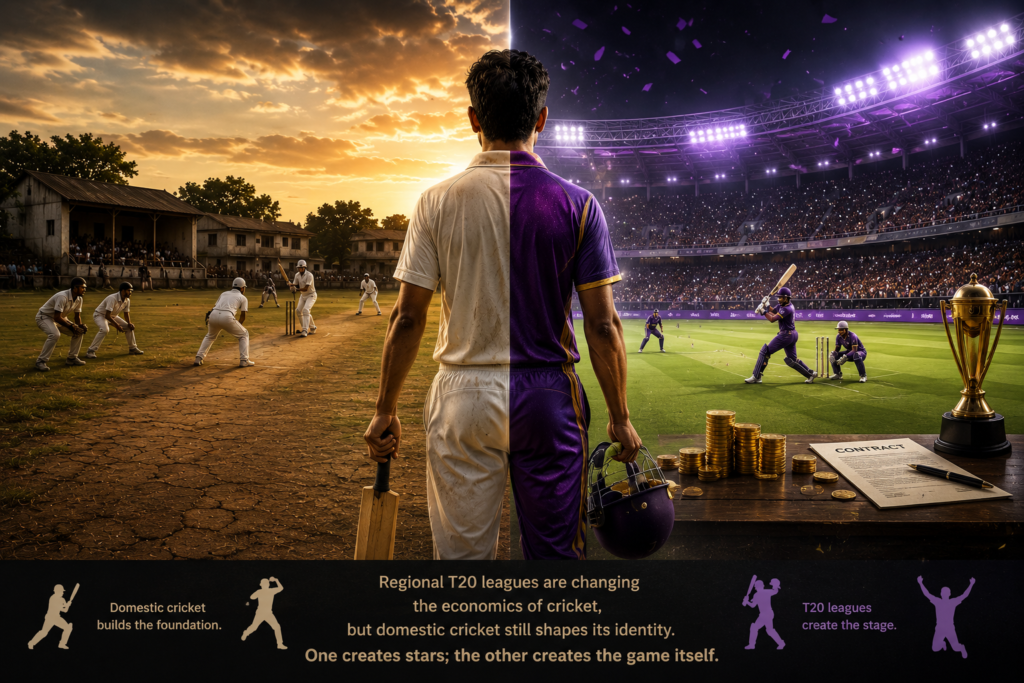
For players, the economics have changed dramatically. A top international cricketer can now earn $2–5 million from franchise contracts in a single year, often exceeding their national central contract. Even emerging domestic players can secure life-changing deals worth 10 to 20 times their domestic salaries after one standout season. Unsurprisingly, many players now prioritize franchise opportunities over lengthy domestic competitions.
This trend has created a significant imbalance. Traditional tournaments such as the Ranji Trophy, County Championship, Sheffield Shield and Plunket Shield continue to develop technically sound cricketers, yet attendance has declined in many regions. While domestic first-class matches often attract only a few thousand spectators, marquee T20 league games regularly fill 40,000 to 90,000-seat stadiums, generating an atmosphere that domestic cricket struggles to replicate.
The calendar also reflects this transformation. In 2026, international and domestic boards have collectively scheduled more than 850 franchise T20 matches worldwide, compared with fewer than 400 first-class domestic fixtures in several major cricketing nations combined. The game’s shortest format is no longer just popular, it dominates the cricketing calendar.
However, statistics reveal another truth. Nearly 90% of current international players still graduated through domestic cricket before reaching franchise leagues. Every explosive batter, every mystery spinner, and every death-over specialist first learned resilience in domestic competitions. Franchise cricket may showcase talent, but domestic cricket continues to produce it.
The emotional cost of this shift cannot be ignored. Generations of fans grew up dreaming of representing their state, county, or province. Today, many young cricketers dream first of franchise auctions rather than domestic caps. While franchise leagues offer wealth and global recognition, they cannot fully replace the heritage, rivalries, and identity that domestic cricket has built over more than a century.

Could Regional T20 Leagues Become Bigger Than Domestic Cricket in 2026?
The future is unlikely to see domestic cricket disappear. Instead, it must evolve. Stronger financial support, better scheduling, improved broadcasting, and greater fan engagement are essential if traditional competitions are to remain relevant. Cricket needs both systems: domestic cricket to build champions and franchise leagues to celebrate them.
By every commercial metric-broadcast revenue, sponsorship, attendance, and player earnings-regional T20 leagues have already surpassed traditional domestic cricket. Yet numbers alone cannot define the game’s future. Domestic cricket remains the foundation upon which every franchise superstar is built. If that foundation weakens, the glittering world of T20 leagues may eventually lose the very talent that makes it extraordinary.
The future of cricket is unlikely to be a battle between regional T20 leagues and domestic cricket. Instead, success will depend on finding the right balance. Domestic tournaments must continue developing future stars, while franchise leagues expand the sport’s popularity and financial strength. Together, they can ensure cricket remains both competitive and commercially successful. Regional T20 leagues may now dominate headlines, but domestic cricket still holds the soul of the game. The challenge for cricket’s future is preserving that soul while embracing the excitement of a rapidly changing era.
“Regional T20 leagues are changing the economics of cricket, but domestic cricket still shapes its identity. One creates stars; the other creates the game itself.”
What is your thoughts on this. Let us know in the comment section below.💬
You can also read:
■ AI Changing Cricket Forever!
One thought on “The Rise of Regional T20 Leagues: Could They Become Bigger Than Domestic Cricket in 2026?”