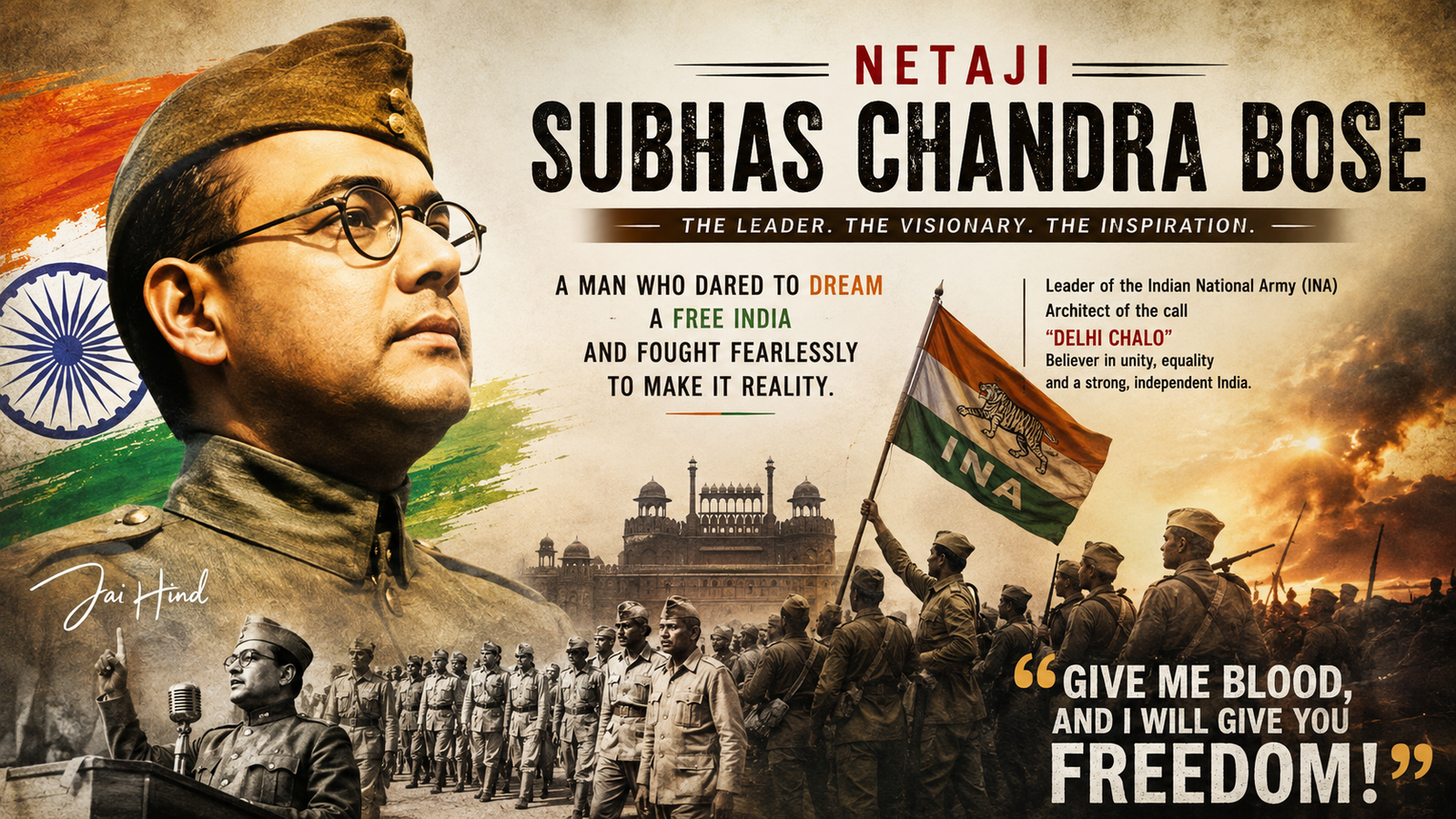
Netaji Subhas Chandra Bose: The Man Who Refused to Surrender India’s Freedom
There are some names that belong to history.
And then there are names that make history tremble.
Subhas Chandra Bose was one of them.
When India was trapped under British rule, millions dreamed of freedom. Some fought with words, some with protests, some with sacrifice. But Netaji Subhas Chandra Bose chose a path that demanded something extraordinary: courage without certainty, sacrifice without guarantee, and faith in freedom even when freedom seemed impossibly far away.
His story is not simply the story of a revolutionary leader.
It is the story of a man who looked at an empire and said, in spirit:
“You may control our land, but you cannot control our destiny.”
A Young Man Who Could Have Chosen Comfort
Subhas Chandra Bose was born in Cuttack in 1897. He was brilliant, disciplined and deeply influenced by ideas of patriotism, spirituality and service.
He achieved something that many young Indians of his generation could only dream of: he successfully passed the prestigious Indian Civil Service examination.
A comfortable career under British administration was within his reach.
But Bose asked himself a more difficult question:
What is the value of personal success when your country is not free?
He chose India.
He resigned from the Civil Service and returned to the struggle for independence.
That decision tells us something important about Netaji. His patriotism was not merely something he spoke about from a stage. It was a choice he made with his own life.
A Different Vision of Freedom
Bose became an important leader of the Indian National Congress and rose rapidly because of his extraordinary energy and organizational ability.
But he believed that India’s freedom could not be postponed indefinitely.
He wanted stronger and more decisive action against British rule. His political differences with the Congress leadership eventually led him away from the organization’s mainstream leadership.
Yet his goal remained the same:
India must be free.
Not someday.
Not when the British decided India was “ready.”
But as a right that belonged to Indians.
The Escape That Became Legend
In 1941, Bose made one of the most dramatic escapes in the history of India’s freedom struggle.
Under British surveillance, he secretly left his house in Calcutta in disguise.
Imagine the scene.
A man watched by the world’s most powerful empire disappears from his own home and begins a dangerous journey across India and beyond.
He travelled through Afghanistan and eventually reached Europe.
Why?
Because Bose was searching for international support for India’s independence.
He understood something crucial: the struggle for freedom required not only courage at home but also diplomacy, strategy and global alliances.
His journey was dangerous.
But Netaji was never a man who allowed danger to make his decisions for him.
The Indian National Army: “Give Me Blood…”
Bose eventually reached Southeast Asia, where he took leadership of the Indian National Army, popularly known as the INA.
For Indian prisoners of war and expatriate Indians, the INA became more than a military organization.
It became a symbol.
A symbol that Indians could organize themselves, fight under their own banner and imagine an India that would no longer bow before British authority.
Bose inspired his followers with words that remain unforgettable:
“Give me blood, and I will give you freedom!”
Those were not comfortable words.
They were a demand for sacrifice.
Thousands responded.
Men and women joined the movement. Among its most remarkable formations was the Rani of Jhansi Regiment, a women’s military unit led by Captain Lakshmi Sahgal.
Bose’s vision was larger than simply removing the British.
He imagined Indians—regardless of region, religion, caste or gender—standing together for one national cause.
His famous call, “Jai Hind,” captured that spirit of unity.
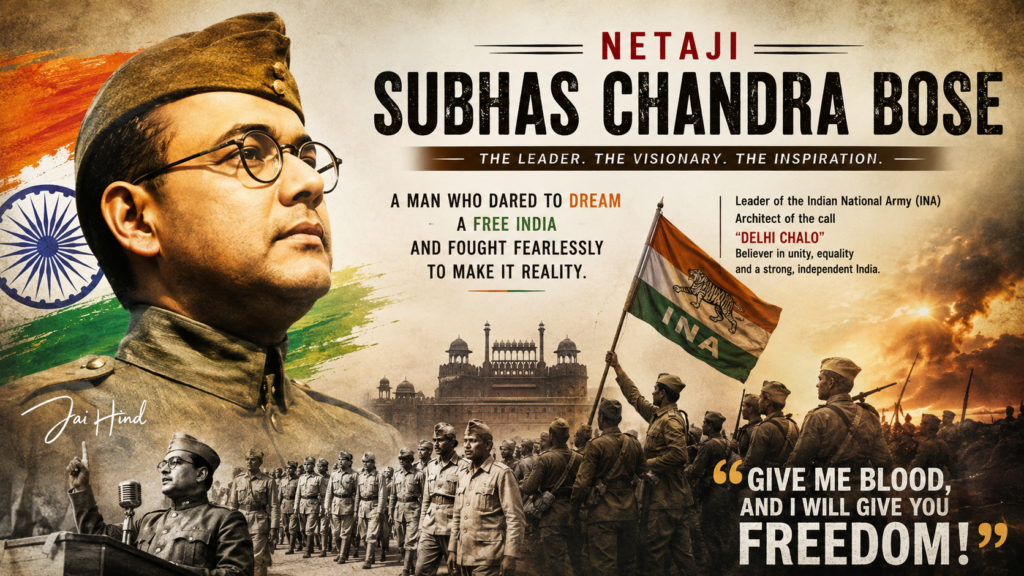
“Delhi Chalo”
Then came another cry that still carries the electricity of that era:
“Delhi Chalo!” – March to Delhi.
The INA advanced toward India’s northeastern frontier alongside Japanese forces during World War II.
Military circumstances eventually turned against them. The INA campaign could not achieve its ultimate objective, and the Japanese surrender changed the situation completely.
But history is not measured only by victories on a battlefield.
Sometimes a movement changes history because it changes what people believe is possible.
And that is where Netaji’s contribution became enormous.
The Battle Beyond the Battlefield
After the war, many INA soldiers were put on trial by the British at the Red Fort.
Instead of crushing the INA’s reputation, the trials generated enormous public sympathy across India.
People saw the soldiers not simply as defeated troops, but as Indians who had risked everything for independence.
The INA story resonated deeply with the public and contributed to a growing crisis of confidence in British rule.
The British had ruled India partly through the strength of their institutions—and partly through the belief that their authority could not be challenged.
Netaji helped shatter that psychological barrier.
His message was simple and powerful:
Indians could fight. Indians could organize. Indians could lead. And Indians could dream of freedom without asking permission.
The Man Behind the Slogan
It is easy to remember Netaji through famous words.
“Jai Hind.”
“Delhi Chalo.”
“Give me blood, and I will give you freedom.”
But behind those words was a human being who understood the price of freedom.
He knew that independence would demand sacrifice.
He knew that his own life might be the price.
And perhaps that is why his story continues to touch young people even in 2026.
Because the world has changed, but the question at the heart of his life has not:
What are you willing to sacrifice for something you truly believe in?
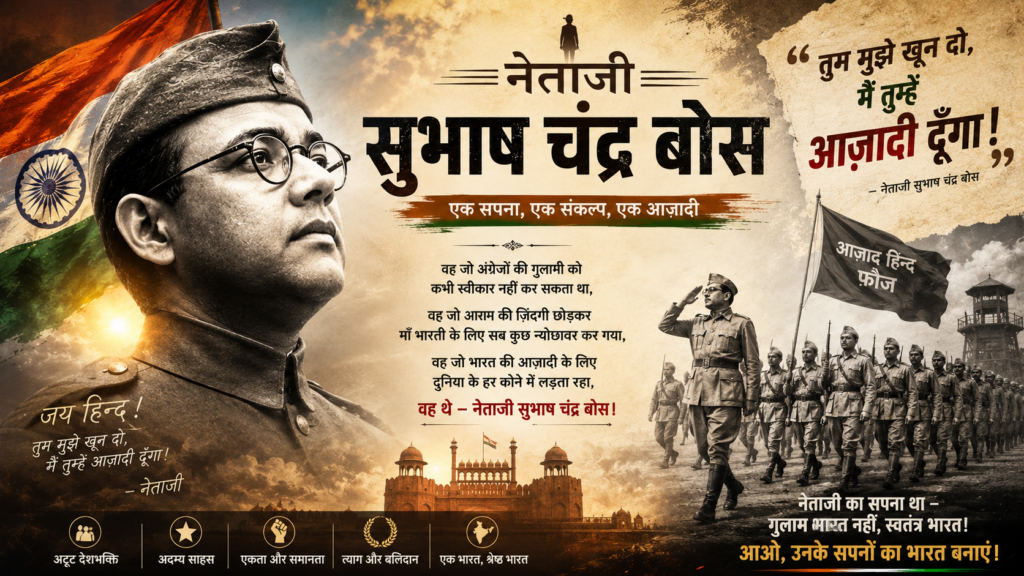
Netaji‘s Greatest Contribution
Netaji Subhas Chandra Bose’s contribution to India’s independence cannot be reduced to one battle, one army or one political decision.
His greatest contribution was perhaps the fire he put into the idea of Indian freedom.
He transformed patriotism from an emotion into action.
He inspired Indians outside the country.
He built the INA into a powerful symbol of resistance.
He gave women a prominent role in an armed nationalist movement.
He challenged the psychological foundations of British authority.
And after the INA trials, the widespread public response demonstrated how deeply his ideas had entered the Indian imagination.
India’s independence was the result of many streams coming together—mass movements, political negotiations, revolutionary activities, sacrifices by countless known and unknown people, changing international circumstances and the weakening of British power after World War II.
Netaji was one of the most extraordinary forces within that larger story.
The Question We Should Ask in 2026
Today, India is independent.
We have our own Constitution, our own institutions and our own future to shape.
So why should a young Indian in 2026 care about Subhas Chandra Bose?
Because Netaji’s real legacy is not simply about looking backward.
It is about asking ourselves what we will do with the freedom that others sacrificed to give us.
Freedom is not only the absence of foreign rule.
It is the freedom to dream.
The freedom to question.
The freedom to build.
The freedom to stand together despite our differences.
And the responsibility to make the country better than we found it.
Netaji lived in a time when freedom seemed like a distant dream.
We live in a time when freedom is our inheritance.
The question is: what will we do with it?
The Story That Refuses to End
The final chapter of Netaji’s life remains surrounded by mystery and debate. But whatever questions remain about his disappearance and death, one fact is beyond dispute:
He left an unforgettable mark on India’s freedom struggle.
His life reminds us that history is not created only by those who possess power.
Sometimes history is created by someone who simply refuses to accept that the impossible is impossible.
Subhas Chandra Bose could have chosen a safe career.
He could have accepted comfort.
He could have remained within the boundaries others had drawn for him.
Instead, he chose uncertainty.
He chose struggle.
He chose sacrifice.
He chose India.
And that is why, decades later, his voice still seems to echo through the pages of history:
Jai Hind.
Not merely as a slogan.
But as a reminder.
A reminder that freedom was never free.
A reminder that courage can awaken millions.
And a reminder that one person’s determination, when joined by the dreams of a nation, can become a force powerful enough to change history.
“Netaji did not simply dream of a free India. He dared to fight for that dream – and inspired an entire generation to believe that the dream could become reality.“
You can also read :